

Muscat
Chedi or Al Bustan — the launching point and a destination in itself.
The Lucalvry view
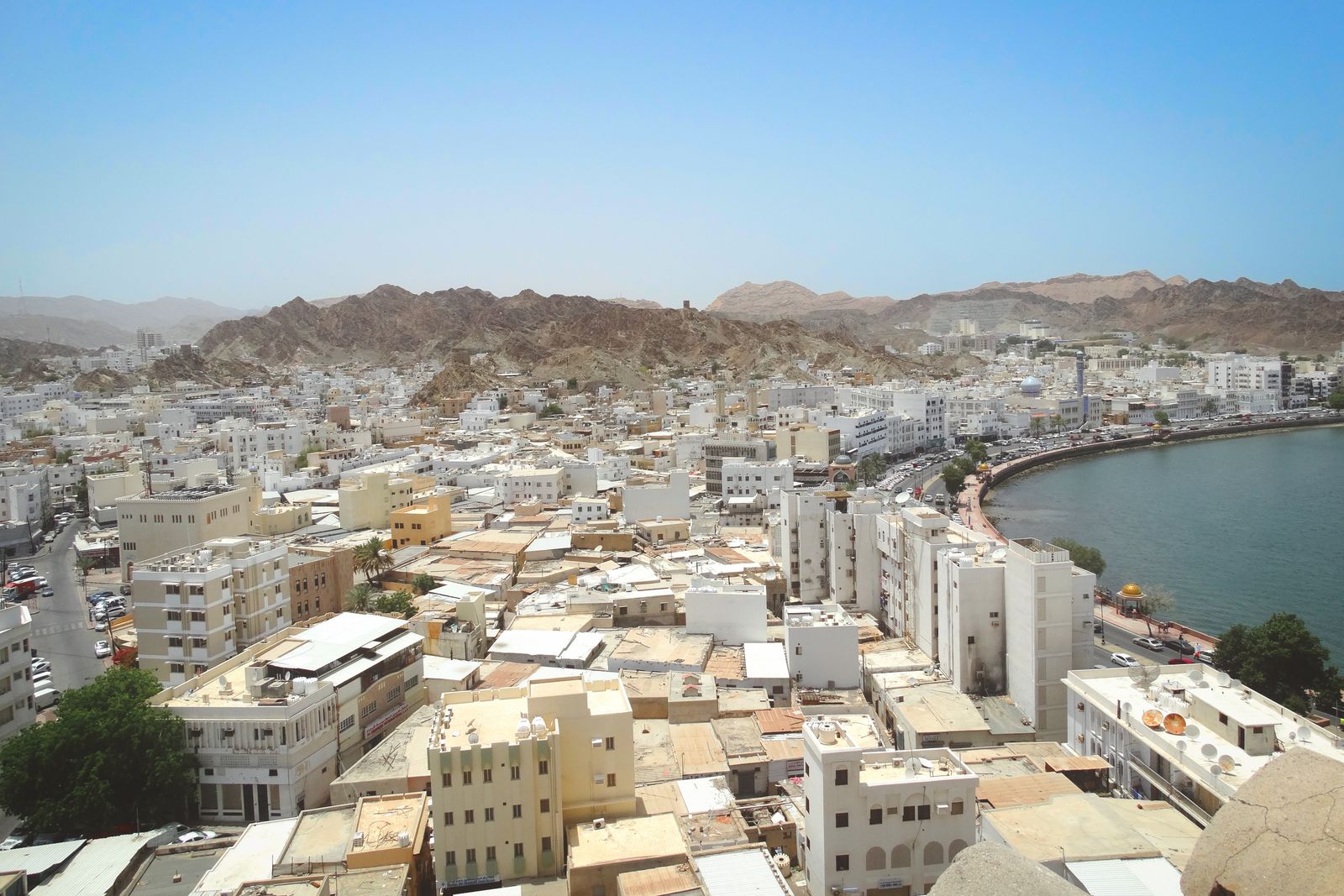
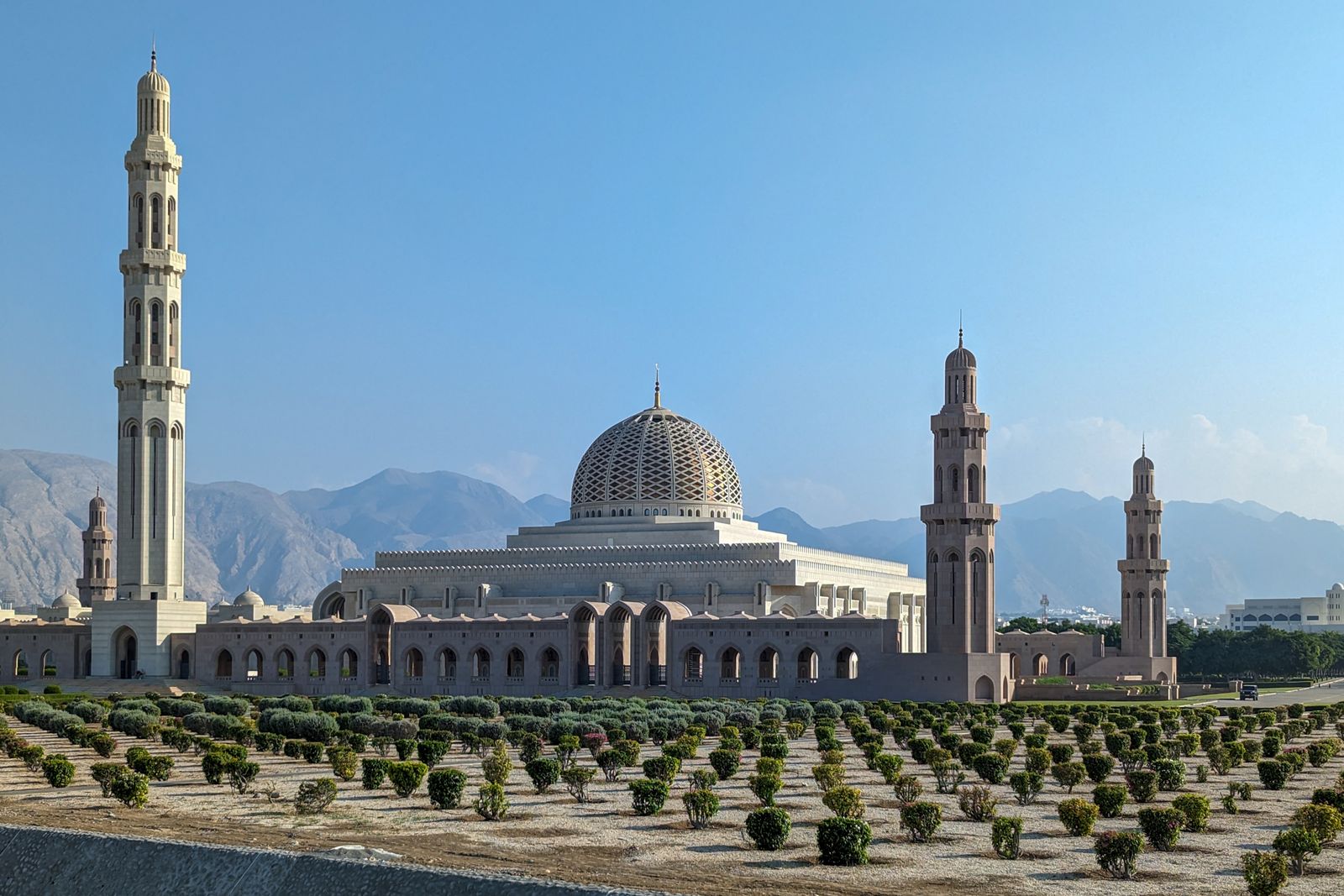
Muscat is the Omani capital and the rare Gulf city that has resisted the skyscraper template — a low-rise white-and-cream sweep along thirty kilometres of Arabian Sea coastline, with the Hajar mountains rising directly behind, the historic Mutrah district at the east end, and a planning code that famously caps building heights at the level of the surrounding palm trees. The right approach is two or three nights as the trip's launching point, treating Muscat as a destination in itself rather than a transit stop; the Sultan Qaboos Mosque alone earns a half-day, and the slow culture of the city — the dhow harbour at Mutrah, the souk's silver and frankincense, the corniche walk at golden hour — sets the tone for the inland mountain weeks that follow.
The luxury anchor is split between three properties that genuinely sit at the global top tier: The Chedi Muscat (GHM's flagship, the long-pool benchmark), Al Bustan Palace (Ritz-Carlton's most cinematic Middle Eastern property, in a private bay east of the city), and the recently-opened Mandarin Oriental Muscat. Skip the chain hotels along the central CBD; the headline experience is the architecture and the coastline, both of which require the right room to deliver.
Neighborhoods
Where to base yourself
Shatti Al Qurm
Stay hereThe luxury beachfront strip — The Chedi, Mandarin Oriental, the Royal Opera House, and the city's strongest dining cluster.
Al Bustan
A private bay east of the city — the Ritz-Carlton's Al Bustan Palace, mountain-amphitheatre setting, the most cinematic stay in Muscat.
Mutrah
The historic harbour district — the souk, the corniche, the fishing dhows. Visited rather than stayed in but absolutely the cultural heart of the city.
Old Muscat (Sur Al-Lawatia)
The walled royal quarter — Al-Alam Palace, the Bait Al Zubair museum, the Portuguese forts. A morning's walk, not a base.
Hotels
Where to stay
- $$$$
The Chedi Muscat
GHM's Gulf flagship — 158 rooms in long-pool low-rise pavilions, Asian minimalist design, the right Muscat anchor before heading inland.
- $$$$
Al Bustan Palace, a Ritz-Carlton Hotel
250 rooms in a private mountain-bay setting east of the city — the most cinematic location in Muscat, with a private beach and the Sultan's former state palace as the lobby.
- $$$$
Mandarin Oriental Muscat
150 rooms on the Shatti Al Qurm beach — the newest five-star opening (2022), the most modern service product in the city.
- $$$$
Shangri-La Al Husn
Adults-only beach resort within the Shangri-La Bar Al Jissah complex — the smartest beach-only stay for couples on a Muscat honeymoon.
- $$$
Kempinski Hotel Muscat
310 rooms with a private lagoon and beach in the Al Mouj marina district — the right value pick for travellers prioritising pool and beach over ultra-luxe rooms.
Dining
Where to eat
- $$$$
The Restaurant at The Chedi
Four open kitchens (Asian, Arabic, Mediterranean, Indian) in one cinematic dining room — the most reliable polished meal in Muscat.
- $$$$
Bait Al Bahr, Al Bustan Palace
Beach-side seafood at the Ritz-Carlton — the catch-of-the-day grilled over coals with Omani lemon-rice, the signature Gulf fine-dining experience.
- $$$
Bait Al Luban
Traditional Omani restaurant in a Mutrah harbour-front building — shuwa (slow-cooked spiced lamb), majboos (rice-and-meat platters), the cultural meal.
- $$
Kargeen Caffe
Garden-courtyard café in Madinat Sultan Qaboos — Omani coffee with cardamom, halwa, sheesha, and the city's most-loved casual dinner setting.
An ideal day
What to do
- Morning
Sultan Qaboos Grand Mosque — the second-largest hand-woven Persian carpet in the world, a 14-tonne Swarovski chandelier. Open to non-Muslims 8.30–11am Sat–Thu, modest dress required (covering provided).
- Late morning
Mutrah Souk — silver, frankincense, pashminas, and Omani daggers. Two hours, then a corniche walk to the fish market and the dhow harbour.
- Lunch
Bait Al Luban for traditional Omani in Mutrah, or back to The Chedi for the polished pool-side option.
- Afternoon
Bait Al Zubair Museum (the best ethnographic collection in Oman) and the Royal Opera House guided tour, or pool time at the resort if you've earned it.
- Evening
Sundowners on the corniche or at the Chedi's beach bar, dinner at Bait Al Bahr or The Restaurant, optional Royal Opera House performance (the season runs Sept–May).
Logistics
Getting around
Muscat International Airport (MCT) is 35km northwest of the city — pre-arrange a hotel transfer (OMR 12, 30 minutes) or use Mwasalat shuttle bus. Within the city, Uber and Careem work reliably, and traditional taxis are plentiful (negotiate the rate before you get in — meters are rare). Hotel cars are the most comfortable option for cultural-site visits. Walking is pleasant along the Mutrah corniche and within Old Muscat but impractical between districts; the city sprawls along 30km of coast. For Jebel Akhdar (2.5h), the Wahiba Sands (3.5h), and Sur (2h), self-drive in a 4WD is the right answer — Avis and Hertz at MCT are reliable, English signage is good, and the roads are excellent.
Cost snapshot
What things cost in Muscat
- Espresso
- $3.50
- Dinner for two
- $50
- Taxi (5 km)
- $7
- 4★ hotel/night
- $200
Numbeo medians, mid-week shoulder season. Verified 2026-05-13.
Best time to visit
Twelve months in Muscat
| Month | Avg high | Rain days | Crowds | Prices |
|---|---|---|---|---|
| Jan | 25°C | 2 | ●●●●● | ●●●●● |
| Feb | 26°C | 2 | ●●●●● | ●●●●● |
| Mar | 30°C | 2 | ●●●●● | ●●●●● |
| Apr | 34°C | 1 | ●●●●● | ●●●●● |
| May | 38°C | 1 | ●●●●● | ●●●●● |
| Jun | 39°C | 0 | ●●●●● | ●●●●● |
| Jul | 36°C | 1 | ●●●●● | ●●●●● |
| Aug | 34°C | 1 | ●●●●● | ●●●●● |
| Sep | 34°C | 0 | ●●●●● | ●●●●● |
| Oct | 35°C | 1 | ●●●●● | ●●●●● |
| Nov | 30°C | 1 | ●●●●● | ●●●●● |
| Dec | 27°C | 1 | ●●●●● | ●●●●● |
FAQ
Common questions about Muscat
- How long do I need in Muscat?
- Two or three nights as the trip's launching point. The Sultan Qaboos Mosque, the Mutrah Souk, the Royal Opera House, and the corniche fill two relaxed days; a third lets you do a half-day boat trip to the Bandar Khairan inlets or a Wadi Shab day-trip from the eastern coast. Beyond three nights, head inland.
- Can non-Muslims visit the Grand Mosque?
- Yes — the Sultan Qaboos Grand Mosque opens to non-Muslims Saturday through Thursday from 8.30 to 11am. Modest dress is mandatory (covered shoulders, ankles, and head for women); abayas and headscarves are provided free at the entrance. Allow 90 minutes; the carpet, the chandelier, and the calligraphy genuinely justify the visit.
- Self-drive or guided?
- Self-drive is the right answer for almost everything — Omani roads are excellent, signage is bilingual, traffic is light, and a 4WD opens the whole interior (Jebel Akhdar, Wahiba Sands, Wadi Shab). Hire the 4WD at MCT on arrival rather than in the city. Guided is sensible only if you want a deeper cultural-history layer or have a tight schedule.
- Best time to visit?
- October to April is the working window — coast temperatures 24–30°C, mountain nights cool, desert days warm but not punishing. December and January are the absolute peak with European winter-escape demand and the highest rates. May to September is genuinely brutal (45°C+ on the coast) and inadvisable for any inland travel; the exception is Salalah in the south during the Khareef monsoon.
- Is Oman safe for solo and female travellers?
- Exceptionally — Oman consistently ranks among the safest countries in the world. Women travel comfortably, drive freely, dine alone, and are treated with genuine respect. Modest dress is appreciated outside resort settings but not strictly enforced. The cultural welcome is one of the warmest in the Middle East.
From the edit
Guides & stays in Muscat
 Hotels
Best Luxury Hotels in Muscat 2026: Six Coastal-Capital Stays Tested
Six Muscat hotels we paid to test in 2026 — the Al Bustan Palace heritage flagship, the Shangri-La Barr Al Jissah resort cluster, and the smartest sub-OMR 220 sleepers in Oman's understated capital.
May 14, 2026 · 11 min read
 Destinations
Where to Stay in Muscat (2026): Shatti Al Qurm vs Al Bustan Picks
The decision-shaped Muscat base guide — Shatti Al Qurm's walkable beachfront against Al Bustan's private mountain cove, with rates, airport transfer minutes, and one named stay per band.
May 16, 2026 · 13 min read
 Destinations
Muscat 2 Nights vs 3 Nights (2026): Launching-Point Routing
The decision-shaped Muscat routing — what the two-night opener covers, what the third night unlocks at Wadi Shab and the Bandar Khairan dhow, and the textbook pattern that pairs Muscat with Jebel Akhdar inland.
May 16, 2026 · 13 min read
Also in Oman
HotelsBest Luxury Hotels in Oman 2026
We tested 17 properties across Oman in 2026. These seven span Muscat to the Empty Quarter, balancing design, wellness, and accessibility.
May 14, 2026 · 8 min
 Hotels
The Best Luxury Mountain Stays on Jebel Akhdar for 2026
Three Jebel Akhdar mountain properties — Anantara Al Jabal Al Akhdar, Alila Jabal Akhdar and Sahab Resort — plus two foothill picks, with the 4WD-only access reality, the canyon-edge view trade-off, and which property actually overhangs the gorge.
May 14, 2026 · 11 min read
 Hotels
The Best Luxury Stays in Musandam for 2026 (Oman's Norway-of-Arabia)
Five Musandam properties — Six Senses Zighy Bay, Atana Khasab, Atana Musandam, Golden Tulip Khasab and the dhow-cruise overnight options — with the UAE-vs-Oman entry reality, the dhow vs paragliding vs snorkelling decision, and the only resort with paragliding-on-arrival.
May 14, 2026 · 11 min read
Sources
- Numbeo cost-of-living — Muscat — verified 2026-05-13
- climate-data.org — Muscat — verified 2026-05-13
Last updated 2026-05-14 by The Lucalvry Edit.