

Seville
Andalusian courtyards and rooftop pools.
The Lucalvry view
Seville is the most atmospheric Spanish city — Moorish palaces, orange-tree squares, and a flamenco tradition that runs as authentic local culture, not tourist theatre. The boutique-hotel scene has matured (Hotel Alfonso XIII, Mercer, Casa 1800) and the city's tapas density is arguably the country's best.
A Seville trip is best in March, April, May or October — mid-summer is genuinely unbearable, often 42°C+.
The two events that genuinely warp the city's calendar are Semana Santa (Holy Week, the week before Easter) and Feria de Abril (two weeks later). Both are spectacular — the Semana Santa pasos through the old quarter at 3am are one of the great living-religious spectacles in Europe; Feria's casetas and rebujito tents are the city at its most theatrically dressed — and both also triple hotel rates, require accommodation booked twelve months out, and reward you only if you accept that all normal sightseeing pauses for the duration. The rest of spring (mid-March through early June) is the editorial window proper. October and the first half of November are the second window — warm days (24–28°C), cold beer still pleasant, and the Real Alcázar gardens at their most photogenic golden hour.
Money is the lightest of any UNESCO-tier European city. A suite at the Hotel Alfonso XIII or Mercer is €350–700 per night outside Semana Santa/Feria; a Michelin-starred dinner at Cañabota is €110 per head; a Bodeguita Romero tapas crawl with three glasses of fino is €25 per head. A flamenco evening at Casa de la Memoria with a copa de vino is €22. The metro is largely irrelevant for tourists (centre is walkable end-to-end in 25 minutes), and a black-cab to the airport is a flat €25. The most common Seville mistake is doing it as a single-night Andalusian-loop stop — two nights minimum, three if you want to fit the Triana sundowner walk and a serious flamenco evening alongside the Alcázar-and-cathedral day.
One Seville rhythm worth respecting: the siesta is real and the city genuinely shuts between 2pm and 5pm in summer. Plan your sightseeing for the morning (Alcázar 9:30am opening, cathedral immediately after), retreat for a long lunch and an actual nap, then re-emerge at 6pm for the second window — Triana cross-river, sunset tapas, late dinner. Fighting the schedule loses you both the cool of the morning and the energy of the night.
Neighborhoods
Where to base yourself
Santa Cruz
Stay hereOld Jewish quarter; whitewashed lanes, orange trees, the most postcard Seville.
El Arenal
Stay hereBullring and river-side; the right base near the cathedral.
Triana
Across the river — flamenco roots, ceramic workshops, working-class authenticity.
Alameda de Hércules
Bohemian quarter with the city's best new restaurants and bars.
Hotels
Where to stay
- $$$$
Hotel Alfonso XIII
1929 Mudéjar-revival palace; the city's grand-hotel address.
- $$$$
Mercer Sevilla
Casa-palacio boutique with 12 rooms and a rooftop pool overlooking the cathedral.
- $$$
Casa 1800 Sevilla
Santa Cruz boutique in a restored 19th-century house; courtyard breakfast.
- $$$
EME Catedral Mercer
Boutique with the city's most spectacular cathedral-view rooftop bar.
Dining
Where to eat
- $$$$
Cañabota
Michelin-starred fish counter; the most refined modern Andalusian dinner in town.
- $$
Bodeguita Romero
Classic Sevillano tapas room; pringá and montaditos at the bar.
- $$
El Rinconcillo
Founded 1670 — the oldest tapas bar in Spain. Order spinach with chickpeas.
- $$
Eslava
Alameda institution; the slow-cooked egg over mushroom cake is the dish to order.
An ideal day
What to do
- Morning
Real Alcázar at opening — Mudéjar palace and gardens, three hours minimum.
- Late morning
Cathedral and Giralda climb; espresso in the orange-tree courtyard at Café Bar Las Teresas.
- Afternoon
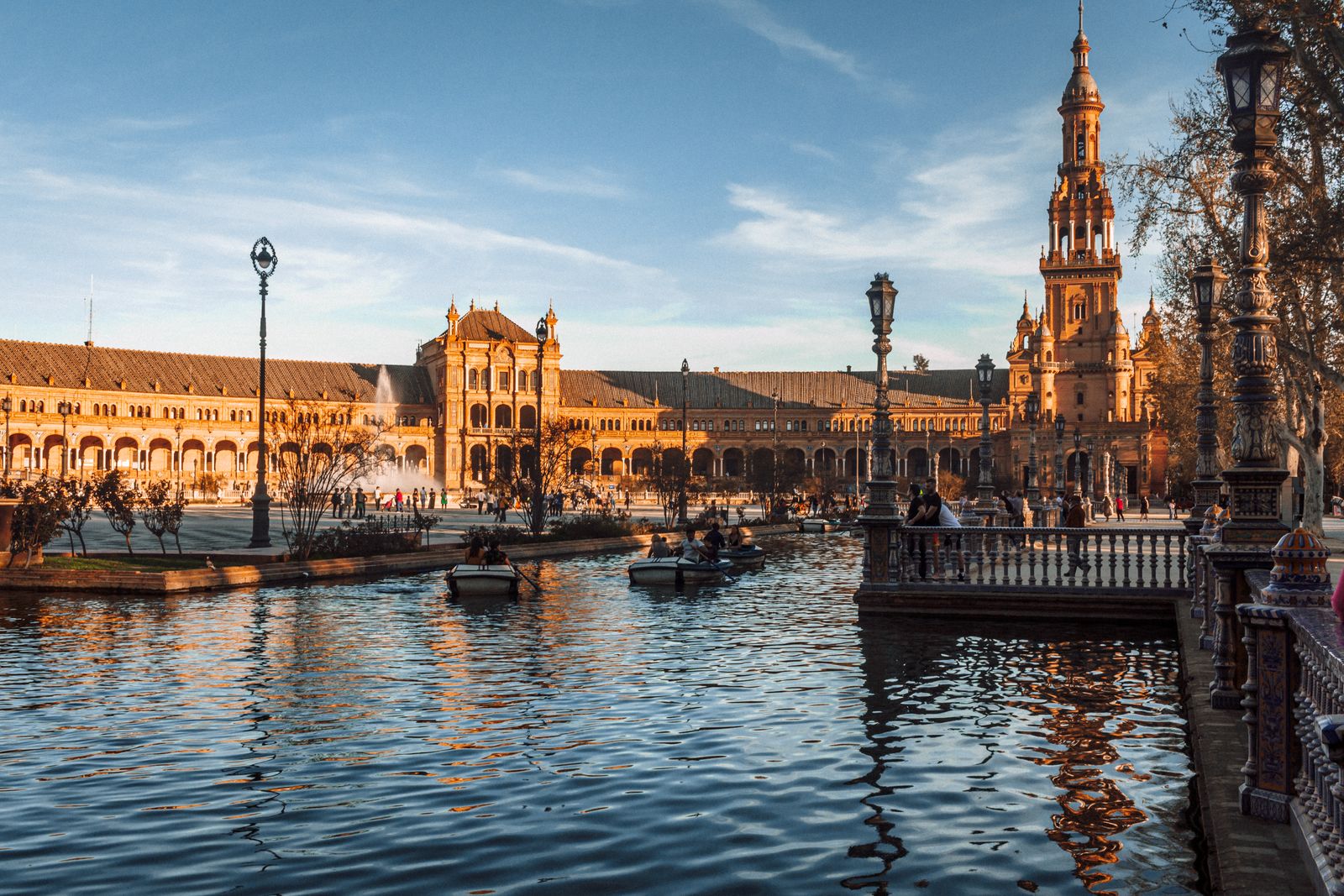
Plaza de España walk through María Luisa Park; flamenco museum if rain.
- Late afternoon
Triana cross-river — Calle Betis sundowner with cathedral view back across the Guadalquivir.
- Evening
Tapas crawl Santa Cruz → Alameda; late authentic flamenco at Casa de la Memoria or La Carbonería.
Logistics
Getting around
Seville's centre is small, flat and entirely walkable — distances between sights are under 20 minutes on foot. The new metro line is more useful for the airport (with a bus connection) than for sightseeing. Skip a rental car for the city; rent only if heading to Córdoba (45 min by AVE — the train is better) or the Andalusian coast.
Cost snapshot
What things cost in Seville
- Espresso
- $1.80
- Dinner for two
- $50
- Taxi (5 km)
- $9
- 4★ hotel/night
- $190
Numbeo medians, mid-week shoulder season. Verified 2026-05-13.
Best time to visit
Twelve months in Seville
| Month | Avg high | Rain days | Crowds | Prices |
|---|---|---|---|---|
| Jan | 16°C | 7 | ●●●●● | ●●●●● |
| Feb | 18°C | 6 | ●●●●● | ●●●●● |
| Mar | 21°C | 6 | ●●●●● | ●●●●● |
| Apr | 23°C | 6 | ●●●●● | ●●●●● |
| May | 27°C | 4 | ●●●●● | ●●●●● |
| Jun | 32°C | 1 | ●●●●● | ●●●●● |
| Jul | 36°C | 0 | ●●●●● | ●●●●● |
| Aug | 36°C | 0 | ●●●●● | ●●●●● |
| Sep | 32°C | 3 | ●●●●● | ●●●●● |
| Oct | 26°C | 7 | ●●●●● | ●●●●● |
| Nov | 20°C | 8 | ●●●●● | ●●●●● |
| Dec | 17°C | 8 | ●●●●● | ●●●●● |
FAQ
Common questions about Seville
- When should I avoid Seville?
- July and August — the city regularly hits 42°C+ and most locals decamp. April for Semana Santa and Feria de Abril is spectacular but accommodations triple in price and book a year out.
- Is the flamenco worth it?
- Yes — but skip the tourist tablaos in favour of the smaller venues (Casa de la Memoria, La Carbonería) where the audience is half local.
- Should I add Córdoba or Granada?
- Both. Córdoba is 45 minutes by AVE (day-trippable for the Mezquita); Granada is 2.5 hours and deserves an overnight for the Alhambra at golden hour.
- When is the best time to visit Seville?
- Mar, Oct. The Spain year has its own rhythm — april–june, september–october.
- Which neighbourhood should I stay in in Seville?
- Santa Cruz — old jewish quarter; whitewashed lanes, orange trees, the most postcard seville.. It puts you within walking distance of most of the editorial picks.
- Which hotels do you recommend in Seville?
- Hotel Alfonso XIII, Mercer Sevilla, Casa 1800 Sevilla, among others. Each is on the page above with a current rate band and the room category that makes the upgrade worth it.
- Where should I eat in Seville?
- Editorial-grade picks include Cañabota, Bodeguita Romero, El Rinconcillo. Book the higher-end rooms three to four weeks ahead, especially in shoulder season.
- How do you get around Seville?
- Seville's centre is small, flat and entirely walkable — distances between sights are under 20 minutes on foot. The new metro line is more useful for the airport (with a bus connection) than for sightseeing.
From the edit
Guides & stays in Seville
 Hotels
Best Luxury Hotels in Seville 2026: Six Andalusian Stays Tested
Six Seville hotels we paid to test in 2026 — the Hotel Alfonso XIII, the courtyard palace boutiques in Santa Cruz, and the rooftop-pool sleepers worth knowing.
May 14, 2026 · 11 min read
HotelsThe 6 Best Luxury Hotels in Seville for 2026
The Hotel Alfonso XIII palace, the new Mercer Sevilla, and the Santa Cruz palace conversions — six properties tested across a paid week in Andalusia's capital.
May 14, 2026 · 12 min read
 Destinations
Seville in 3 Days: The Lucalvry Itinerary
A walkable three-day Seville itinerary — the Alcázar at opening, the Cathedral and Giralda before the heat, the Triana barrio at golden hour and the four tapas bars worth booking ahead.
May 15, 2026 · 12 min read
Also in Spain
HotelsThe 6 Best Luxury Hotels in Barcelona Right Now (2026)
Six Barcelona addresses worth the rate card — the Passeig de Gràcia palaces, the Eixample boutiques, and the Barceloneta beachfront properties that have rewritten what a Mediterranean city hotel can be.
May 13, 2026 · 12 min read
 Destinations
Where to Stay in Barcelona: A Neighbourhood-by-Neighbourhood Guide (2026)
The five Barcelona neighbourhoods worth basing yourself in — Eixample, Born, Gothic Quarter, Gràcia and Barceloneta — with the hotels, restaurants and trade-offs that decide your week.
May 13, 2026 · 10 min read
DestinationsBarcelona in 3 Days: The Lucalvry Itinerary
An hour-by-hour Barcelona route designed to walk Sagrada Familia at opening, eat through the Born after dark, and end the trip on a Passeig de Gràcia rooftop. Named hotels, named restaurants, walkable distances throughout.
May 13, 2026 · 12 min read
Sources
- Numbeo cost-of-living — Seville — verified 2026-05-13
- climate-data.org — Seville — verified 2026-05-13
Last updated 2026-05-13 by The Lucalvry Edit.